

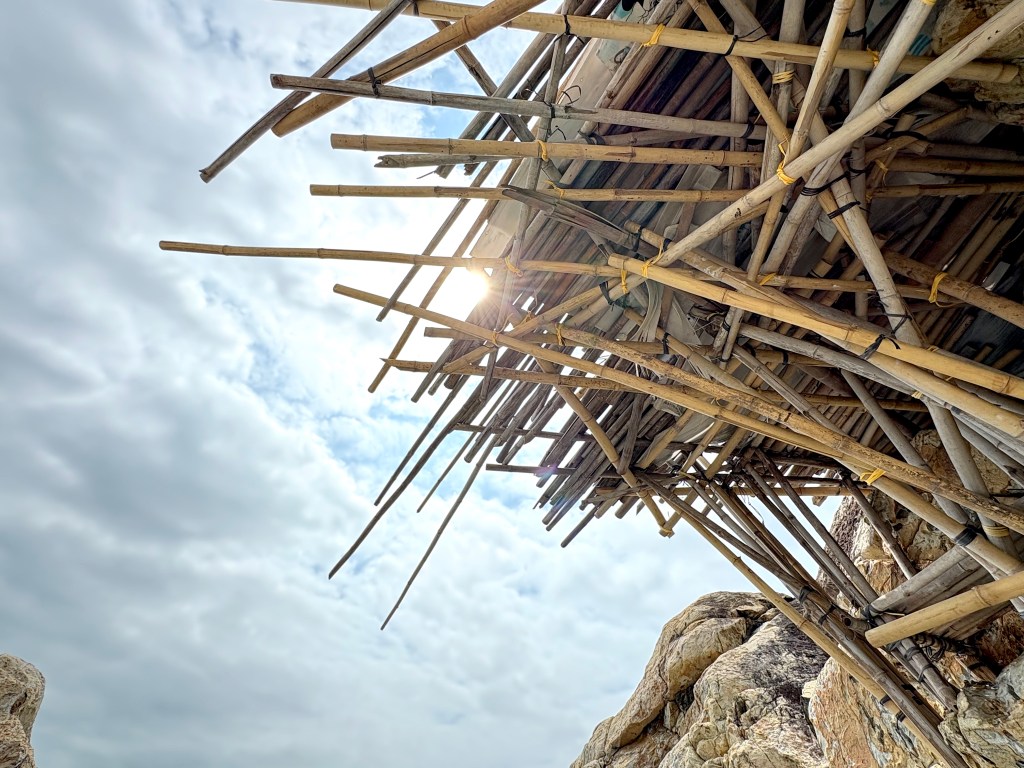
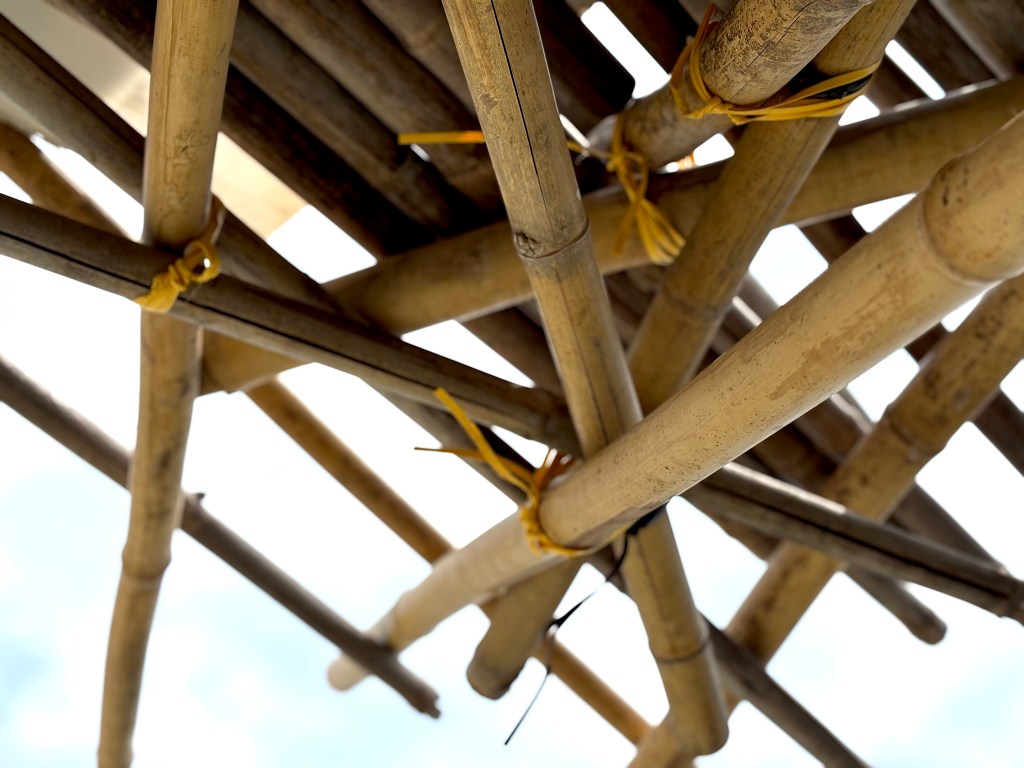
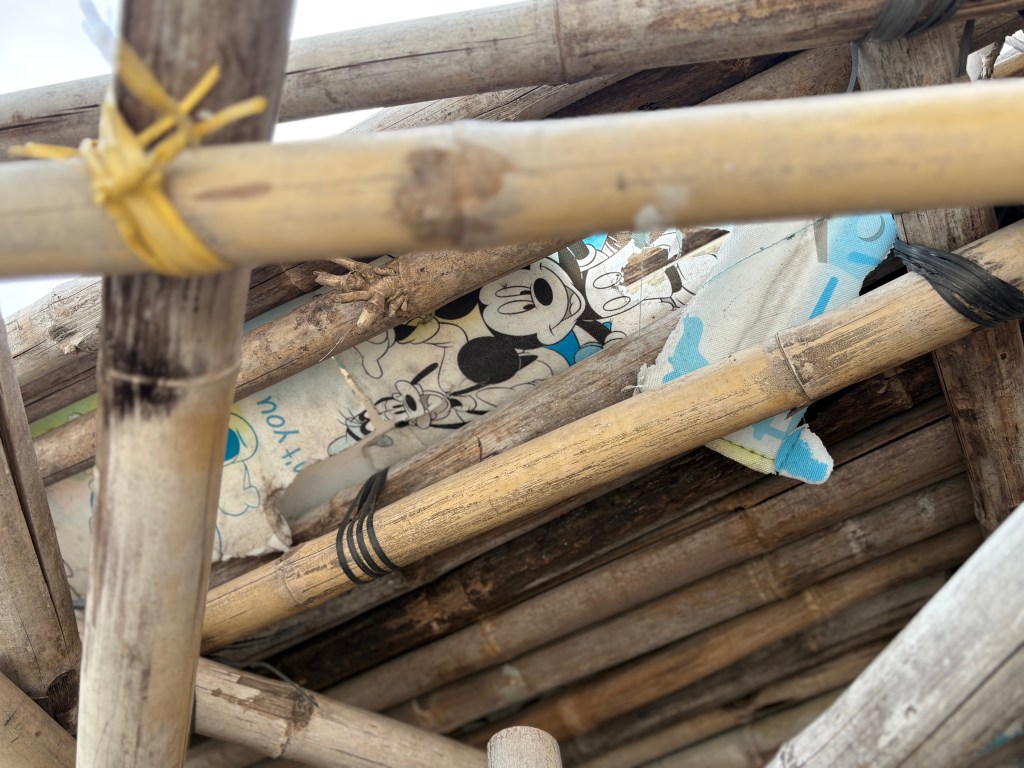
While coasteering along a cliff face in Ap Lei Chau, Hong Kong, our group stumbled upon this bamboo structure. No screws, nails, or mortar. Just bamboo, plastic ties, and remnants of a sunbleached tarp of Mickey Mouse and friends.
This structure’s anonymous builders applied a flexible grammar of connection techniques: a protocol for joining bamboo, adapted to the specific instance of this cliff face, solving a particular challenge created by this combination of space and materials. Just as similar building methods might appear across the dozens of other countries where bamboo is used in construction, each implementation can respond uniquely to its particular context (legal, climactic, or otherwise).
This grammar-like adaptive quality allows the structure to remain coherent, while accommodating unique sites, locally available materials, and the skill and functional needs of its creator(s). The bindings follow consistent patterns, but vary in their specific application – tighter where structural integrity demands it, looser where flexibility is more beneficial. Such a protocol’s resilience comes from providing principles of connection, without dictating specific forms. Indeed, construction, at its core, often follows protocols that must balance structure with adaptability. The tradition of bamboo scaffolding in Hong Kong, for example, is a striking instance of an architectural protocol that allows for rapid assembly, dismantling, and site-specific customization.1
Each pattern is a field – not fixed, but a bundle of relationships, capable of being different each time that it occurs, yet deep enough to bestow life wherever it occurs.
_Christopher Alexander, “The Timeless Way of Building”
This bamboo shelter exhibits what Christopher Alexander in “A Pattern Language” might also identify as a “pattern”, with its balance of formality/structure with the necessity of adaptation/improvisation. Much as the protocol/pattern that inspired its creation, it is rigid and formal enough to stand against the elements, while flexible enough in its “open-source” stance to embrace augmentation and repair as any inclined user sees fit.
Unlike buildings designed to impress or endure indefinitely, this was designed to respond to immediate needs with available resources, creating a shelter that is precisely adequate for its purpose – accomplishing a site-specific job in an unforgiving environment.
Notably, the parts of this planet considered “unforgiving” are expanding daily. As James Bridle writes in Ways of Being, plants (in this case, the dandelion in his backyard) would need to move between 10-15 meters each day to keep pace with shifting climate zones brought on by global warming. Working with minimal means and maximum ingenuity, this structure’s builders are forerunners of our collective future, a preview of what awaits us all as climate collapse disrupts supply chains and limits once-abundant resources. Such ways of designing and building will shift from the margins to the mainstream, and today’s site-specific material improvisations will become tomorrow’s essential adaptations.2 With their density and resulting spatial/resource constraints, cities will likely prove to be ground zero for this shift:
Protocols are essential to cities. The physical concentration of thousands or millions of people and the intersection points of myriad local and global systems, all competing to use the same finite space, are places of constant compromise at every scale, full of externalities that must be managed, boundaries that must be negotiated, and conflicts that must be resolved.
_Drew Austin, “Protocols Don’t Build Pyramids”, in “The Protocol Reader”
These adaptive approaches to building with limited resources aren’t just relevant to climate resilience, either. They offer a blueprint for rethinking how we build across both physical and digital domains, and how we might inspire across organizations.

Small. Flexible. Modular. Abundant.
Indeed, this sort of Small is Beautiful approach to physical construction of “build small, for small audiences, with local materials” parallels the recent evolutions towards how digital builders are creating small, low-resource applications, supplanting the data-hungry platforms targeting billions of users as computational and energetic limits assert themselves. It echoes what Dan Hill saliently observed about the vehicles plying Shanghai’s streets – open source, open framed platforms (in all senses of the word “platform”):
…spend five minutes on these streets and aspects of this ‘distributed dispersal’, flexibility and small scale are all on show… most vehicles are bikes, whose open form factor allows their loads to grow in all directions, as far as physics and the rider’s skill will allow.
_Dan Hill, “Small Vehicles of Shanghai — DeepSeeking the city”
Dan also points out the parallels between digital and physical building, and in particular low-resource building as a sharp contrast to many other industrialized contexts’ resource-intensive digital and physical construction techniques. Whimsically imagining what Shanghai’s metropolitan government might have as guidance for implementing its urban strategy, the very same could apply to a more ideal vision of a way of building friendlier to novice software developers and general biospheres occupants alike:
an indeterminate playground for ‘small pieces loosely joined’, open, cheap, lightweight, adaptive… eliding open and natural systems, software and architecture, via forms of thinking about modularity and patterning…
_Dan Hill, “Small Vehicles of Shanghai — DeepSeeking the city“
Indeed, the way he describes the shape of a more ideal city street applies also to a digital environment in which I’d like to spend more time:
…such permeability and flexibility allows for streets to be generative, resilient, adaptive, and directly accessible more broadly. More everyday, if you like. Full of city life.
_Dan Hill, “Small Vehicles of Shanghai — DeepSeeking the city“
This structure demonstrates the practical approaches we could adopt in contemporary design – not just physically, but also digitally – as tools like Cursor, Manus, and Lovable make it simple to create small, flexible, legible, accessible and easily maintainable digital things. Software with a target audience the size of which might fit under a single (bamboo) roof could become the norm rather than the exception.

Building software with the same principles visible in our bamboo structure, favoring flexibility and accessibility over monolithic scale, and using at-hand materials to create something fully usable and enjoyable, non-engineers can now assemble functional software without the backing of massive development teams and VC funding. Just as not every shelter need be a skyscraper, not every digital product need serve billions.
Lowering barriers to building also lowers the pressure to maximize scale and speed, so aspiring builders are more free to define a meaningfully specific audience far smaller than “everyone, everywhere.” As tools unlock our ability to create to catch up closer than ever to our ability to imagine nearly boundless possibilities, knowing when to stop building will become perhaps the most consequential design decision.
Fertile incompleteness.
Whether electric scooter, bamboo structure, or even city itself, the “unfinished” essences of their structures serve a purpose. This “fertile incompleteness” – deliberate gaps that invite adaptation rather than prescribing the creator’s idea of a “final form”, create more space for innovation than their “walled garden” resistant-to-modification alternatives (think NIMBY-filled gated communities, Teslas, John Deere tractors, etc.).
My favorite example of this is Alejandro Aravena’s post-earthquake housing in Chile. His studio Elemental’s “half a good house” provided essential infrastructure – foundations, load-bearing walls, and utilities – but left space for future residents to complete their homes on their terms, according to their own diverse needs (instead of an architect’s assumption of them).
Architects design nouns – windows, ceilings, floors – but these nouns come from verbs which are life itself. Looking, eating, meeting. We should be looking at both nouns and verbs.
_Alejandro Aravena, “the shape of things to come“
With resources concentrated on building the core essence of each home, there was room intentionally left for life to fill in the rest. In this, we see the power of fertile incompleteness – intentional structural openness becoming a catalyst for growth, agency, and resilience. The balance of structure and adaptability – again, like protocol used to design this structure in the first place – embodies how more open innovation could ideally work: provide a solid foundation, but leave space for others to contribute and iterate the solution beyond its initial design.
Constraints, thoughtfully applied.
Whether crafting physical structures or digital experiences, we are now facing similar imperatives: to build with what’s available rather than what’s ideal, to create systems that users can adapt rather than merely consume, and to embrace the humility of designing for sufficiency rather than excess.
Where more “bespoke” software can differ is in its deliberate choice of constraints: while the tools now exist to build at massive scale, a growing community of newly-empowered tinkerers are intentionally choosing to play with more limited scopes and smaller audiences (sometimes just designing for themselves), recognizing that meaningful, sustainable digital experiences often emerge from thoughtful limitation and the notion of “just enough” rather than endless expansion as software’s raison d’etre. I’ve been fascinated to see what the people in Nat Eliason’s “Build Your Own Apps” course have vibe-coded into existence to date.3
This improvised bamboo shelter, clinging to the face of a cliff on Ap Lei Chau Hong Kong embodies wisdom we need as we face our uncertain future. Resilient systems embrace the creative potential of constraints, thoughtfully applied. Use simple materials to solve specific problems, and remain adaptable. Work within boundaries — whether material, financial, or computational — while leaving room for modification, and you’ll produce more resilient solutions than if you designed for infinite scale assuming unlimited resources.
- For an absolutely beautiful explanation of how bamboo is, even today, extensively used in the city’s construction industry, enjoy this beautiful visual feature from SCMP. ↩︎
- Auburn University’s Rural Studio program, and in particular their Masons Bend Community Center is an example relying upon synthetic materials, while Julia Watson’s lushly visual tome Lo-TEK contains a myriad of more organic examples. ↩︎
- Examples include a plywood cutting visualization tool for DIY enthusiasts, an emotional wellness tracker for those interested in measuring their moods in a personalized way, and a cyberpunk-style breathwork timer, amongst many others. ↩︎
 Square Inch Anthro / 平方英寸人类学