
This isn’t my usual format, but Steph Ango’s conversation with Jackson Dahl on the Dialectic podcast hit me at just the right moment. I kept pausing, rewinding, taking notes—so I figured I’d share three quotes (of many, many good ones) that stood out, and how they spoke to me as I sat at home, coding and thinking.
“What can we remove?” / “Great tools choose to be bad at some things.”
[00:22:35]
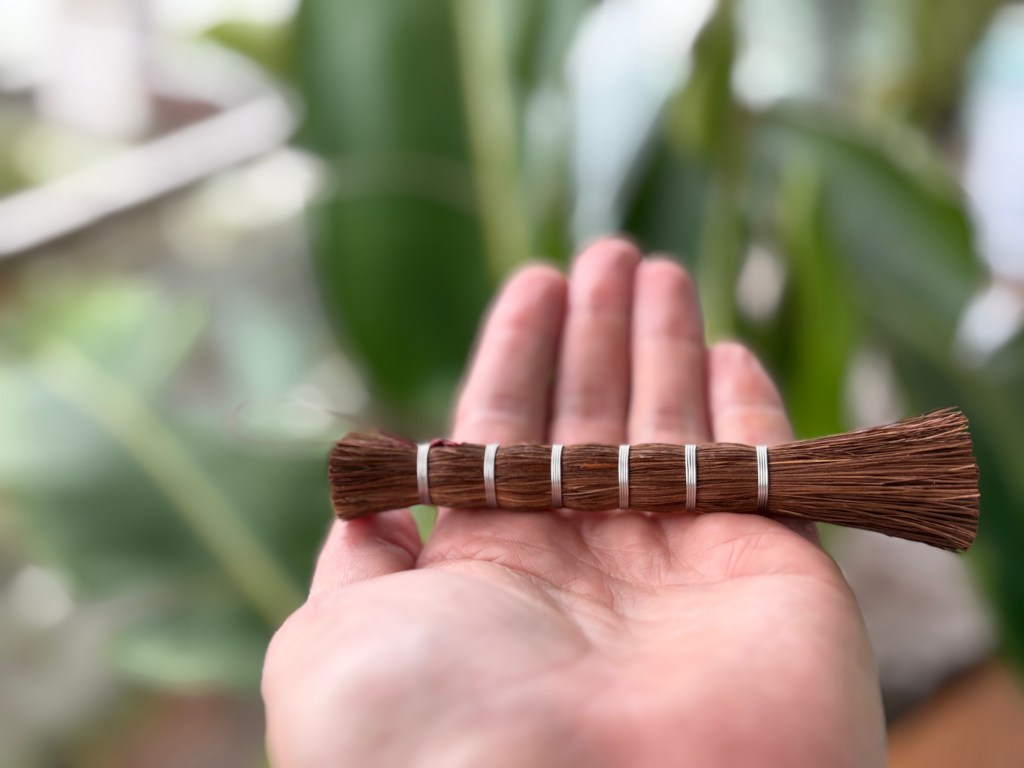
From stones smudged with the calligraphic ghosts of ink residue, to packed temple courtyards where dust rises like morning prayers, to monsoon-slicked market floors strewn with rice husks and vegetable scraps—each of the thirteen brooms and brushes hanging on my wall speaks to a surface, and to a way of expressing care. The initial few picked up on a whim during a trip through Taiwan, and later expanded on other journeys, they form a humble collection of human-surface interfaces.
For the tinest of them, the suzuri hoki 硯箒 — a index-finger sized implement designed to clean ink stones — its power lies in its radical particularity. In choosing to do this task well, its creators disqualified it from many other tasks, embodying Ango’s belief that “great tools choose to be bad at some things.”
I was in pursuit of this very same deliberateness when I sat down at the magical spinning loom of Cursor, an AI-assisted coding environment, to create something similarly simple and focused.
“File over app”
[01:33:08]
CAFteria was born from the need to liberate over 200 recordings from my research on Chinese three-wheeled vehicle drivers from the digital amber of Apple’s proprietary .caf format. “Core Audio Files” are unable to be digitally transcribed, and existing conversion options forced a choice between a clunky workflow that depended upon the terminal, or navigating ad-laden websites. Even if I’m the only person who ever uses it, it remains dear to me.
It struck me how many companies invert Ango’s philosophy of “file over app”, undermining their users’ freedom to access the files they created with their tool, speaks to, as Ango put it, how “the software ecosystem is really geared towards selling back access to your own data.” I’d known this in the abstract, but hearing it phrased in this way underscored the absurd audacity of the relationship. This architecture of dependency, taken as a given, contradicts what makes a good tool truly empowering – how it amplifies users’ capabilities rather than diminish them.
“We still need a comfortable place to sit”
[00:55:57]
Another resonant thread of Ango and Dahl’s discussion offered a re-centering perspective amidst a blur of hyper-speed everything: “A lot of our needs as human beings have not changed at all for thousands of years. We still need a comfortable place to sit, a comfortable utensil to put food into our mouth.”
While everything from news cycles to LLM development accelerate by the week, they stand in stark contrast to the ‘technologies that we no longer even recognize as technologies’ (to once again dust off my favorite quote from author William Gibson):
“…[life is] all happening very near the apex of a pyramid of once-emergent technologies, so we’re up at the apex – if any of those other layers below went out on us, we’d all die. We forget that. That we’re at the peak of something, but we’re supported by older technologies that we no longer even think of as ‘technologies.’”
_William Gibson, Technology, Science Fiction & the Apocalypse
This is where the simple acts of care and maintenance enabled by the humble broom, a “technology” that has remained relatively unchanged for centuries, comes to the fore. The broom has not stagnated, but rather, been perfected. Achieving a form fully aligned with human need and its environmental context renders further change unnecessary. The most profound technological achievements aren’t those that untether human abilities, but rather those that fulfill human needs with greater elegance, accessibility, and permanence.
The suzuri hōki and CAFteria don’t represent opposing philosophies but complementary truths about progress.
They remind us that innovation’s pace should be governed by the problem being solved. Our most fundamental needs have always been close to the earth: a place to sit, a meal to share, a surface to tend with our hands. They needn’t keep pace with the machines we build or the galaxies we reach for. These are the very layers we live upon. And if they falter, it won’t be because we’re short on tools, but because we failed to maintain the ones that most mattered.
*Postscript: If you are still unsure whether to give it a listen Ango and Dahl also talk at length about:
- The parallel prismatic universes of Olafur Elliasson’s art
- The fractal and recombinant nature of Justice’s music
- Fibonacci sequences/spirals
 Square Inch Anthro / 平方英寸人类学