

Milan’s care for its transit passengers, and all of its citizens, can be read through a grammar of the city’s grips.
Five years after it premiered, the curved steel tubing of Franco Albini’s 1959 Tre Pezzi armchair (or “Three Pieces”) became the handrails of Milan’s first metro line. Albini’s mastery of materials had seen him design everything from chairs, to bookshelves, to entire department stores. In his hands, furniture’s more fleeting sensibilities were instilled into Milan’s transit infrastructure, reimagining high-end domestic comfort at an urban scale.

Before subterranean trains mimicked designer furniture, leather straps in Milan’s Series 1500 trams conveyed the same depth of care and thoughtfulness aboveground. Built from 1928 to 1932, around 135 of the original 502 still ply Milan’s streets today. Nearly a century of hands has polished these Bakelite handholds into haptic timelines, with wear patterns mapping Milan’s circulatory commute rhythms.
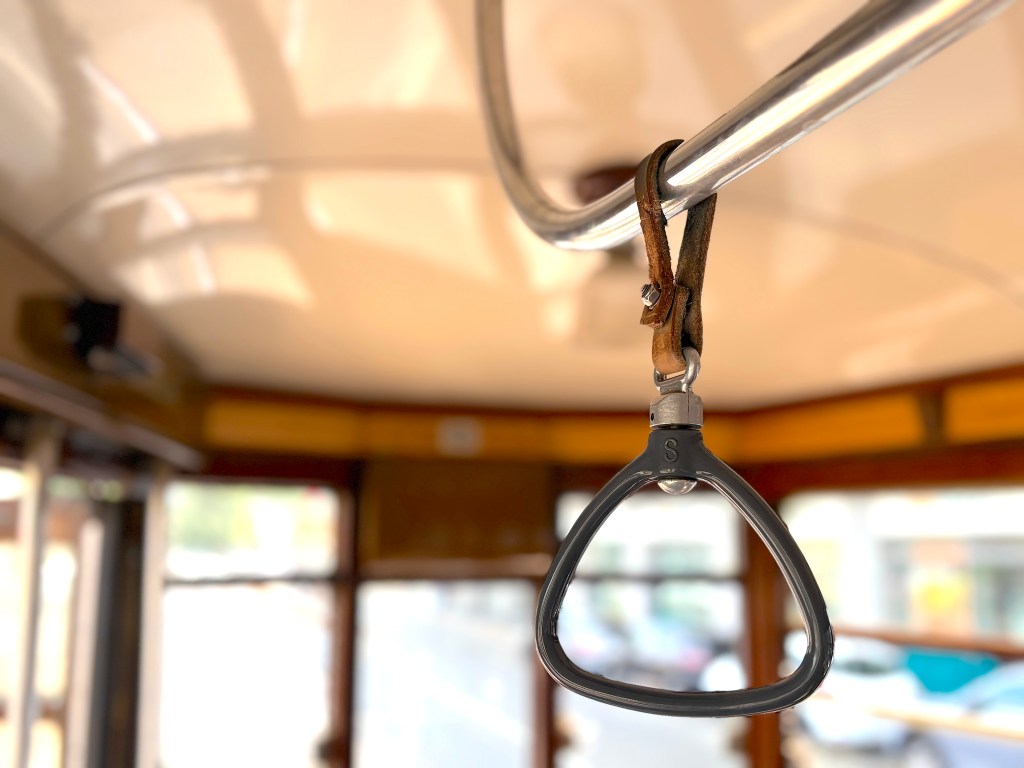
Such thoughtful design DNA does not weave itself together in straight, predictable lines. The same care instilled in Milan’s public transport grips and rails can be found across the city today. Details like the design of a restaurant chair’s backrest bar echo the care of these transport touchpoints, if not their precise form factor. Echoing another sort of velocity – a cyclist’s grip tape, perhaps? – this small design touch closes a satisfying feedback loop: chairs inspire infrastructure inspire chairs, and so on.

When cities commit to tactile dignity and care at the infrastructural level, cultural expectations constellate and cascade. If each surface is considered as an opportunity for thoughtful engagement, the simple act of navigating across a city can inspire deeper thoughtfulness in how one thinks and sees.

Why does any of this matter, though? When infrastructure dignifies and honors the fundamental gesture of gripping, holding, touching, it establishes cultural literacy around material interaction. Infrastructure can become a curriculum of care, with every surface embodying an ideal of thoughtful engagement.
Long before “interfaces” were things built from pixels, the designer Bob Noorda (Albini’s collaborator on the design of Milan’s Line 1) stated his goal for the metro’s future visual system as “an interface where products and services speak to citizens in synthetic language.” Consider this framing at the scale of a city, and how it speaks to inhabitants across Milan’s smallest public details.
What surfaces can you recall from your own commute? When does functional urban design transcend utility to become part of a place’s cultural DNA?
 Square Inch Anthro / 平方英寸人类学